The Loschmidt Echo
Homepage
 Josef Loschmidt Josef Loschmidt
|
The study of the
Loschmidt Echo is an ongoing international collaboration with people from
Latin-America and Europe.
Up to now, the
people involved are the following:
-
Horacio M.
Pastawski (FAMAF, Córdoba, Argentina)
-
Patricia R.
Levstein (FAMAF, Córdoba, Argentina)
-
Rodolfo
Jalabert (IPCMS, Strasbourg, France)
-
Fernando M.
Cucchietti (FAMAF, Córdoba, Argentina)
-
Gonzalo Usaj
(Duke University, Duke, USA)
-
Diego A.
Wisniacki (CNEA, Buenos Aires, Argentina)
-
Eduardo
Vergini (CNEA, Buenos Aires, Argentina)
-
Eduardo R.
Mucciolo (PUC, Rio de Janeiro, Brazil)
-
Caio H.
Lewenkopf (UERJ, Rio de Janeiro, Brazil)
-
Raúl O.
Vallejos (CBPF, Rio de Janeiro,
Brazil) |
The study of the
Loscmidt Echo started in 1995 with NMR experiments in many-body spin systems
[1]. There, a hipersensitivity of time reversal to perturbations was found,
along with a characteristic decoherence time roughly independent of the
perturbation. In these experiments, quantum irreversibility is monitored through
the attenuation of the amount of revival of a local density excitation upon time
reversal of its quantum evolution, i.e. the Loschmidt Echo. Its mathematical
expression is quite simple,
M(t) = |<0|
exp(it(H+S)) exp(-itH)
|0>|^2
Where |0> is an
initial state of the system, H its Hamiltonian, and S the perturbation. The first attempt to explain the
experimental results used that such a complex many-body system could be assumed
to be chaotic. This was reinforced by the fact that the decoherence time was
found to be proportional to the only dynamical scale of the system. Using
analytical semiclassical theory, Jalabert and Pastawski [2] predicted that if
time reversal were attempted in a classically chaotic system, when a quenched
disorder perturbation is present, the Loschmid Echo would attenuate
exponentially. Notably, its decay rate is only determined by the Lyapunov
exponent of the classical system.
A bunch of numerical
has come out since then. Using different systems, methods and perturbations, we
are exploring the limits of the theory (parameter ranges, soft chaos, etc). The
main results have been obtained in the Lorentz Gas, the Bunimovich Stadium and
the Smooth Billiard, all standard examples of classical chaos. Some nice
pictures are available in this page, but for the serious work see [2] and
[3].
[1] P. R. Levstein, G.
Usaj and H. M. Pastawski, J. Chem. Phys. 108, 2718 (1998); G. Usaj, H. M.
Pastawski P. R. Levstein, Mol. Phys.95, 1229 (1998); H. M. Pastawski, P.
R. Levstein, G. Usaj, J. Raya and J. Hirschinger, Physica A 283, 166
(2000).
[2] R. Jalabert and H.
M. Pastawski, Phys. Rev. Lett. 86, 2490 (2001)
[3] F. M. Cucchietti, H.
M. Pastawski and D. A. Wisniacki, Phys. Rev. E 65, 045206(R) (2002)
The Lorentz
Gas
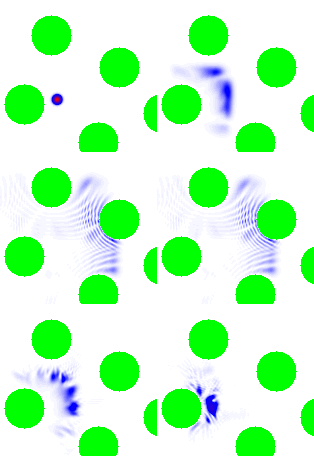
We consider a particle
in a square billiard of area L^2 where we place an irregular array of N circular
scatterers of radius R.
(a) A
particular realization of such system, where the length, in a minimal unit a, is
L=200a. In the center of the figure is the density of the initial Gaussian wave
packet.
(b) The density
resulting from the evolution of the initial state in (a), where the initial
momentum points to the left. The propagation time is t=30 \hbar/V.
(c) An
evolution for an equivalent time, but with the perturbed Hamiltonian H+S
(d) Evolution
for time t=30 \hbar/V with Hamiltonian (-H+S) of the
state depicted in panel (b)
While the densities in
panels (b) and (c) look similar to the eye, the corresponding square of the
overlap, M(t), between both
evolutions is about 0.09 indicating the relevant role of the quantum phase.
Here are the animated
sequences of the system shown above, with the Forward (H) Backward (-H+S) evolution (zoomed for convenience)
(The file has 118Kb,
so be patient)
The Smooth
Billiard
As stated above,
another system where the Loschmidt Echo is being investigated is the Smooth
Billiard, which is defined by the potential
|
y^2n |
for
0<x<a |
| V(x,y) = |
(x^2+y^2)^n |
for
x>a |
|
infinity |
otherwise |
The exponent n sets
the steepness of the confining potential. For n=1 the smooth stadium is
integrable. As the value of n is increased, the borders become
steeper. In the limit of
n->infinity, the stadium gains hard walls, becoming the well-know Bunimovich
billiard. Thus, by varying n, we can tune the system dynamics from integrable to
progressively more chaotic and study the behavior of the Loschmidt Echo in this
situations.
A little animation
showing the evolution of a wave packet in this system (266 KB) is below. Later
on I will add some time reversal animations...

The Bunimovich
Stadium
This section is under
construction
For more information
contact Fernando M.
Cucchietti


